Roots that resonate

| Type of post: | notice |
| Sub-type: | No sub-type |
| Posted By: | Claud Fullwood |
| Status: | Current |
| Date Posted: | Sun, 17 May 2026 |
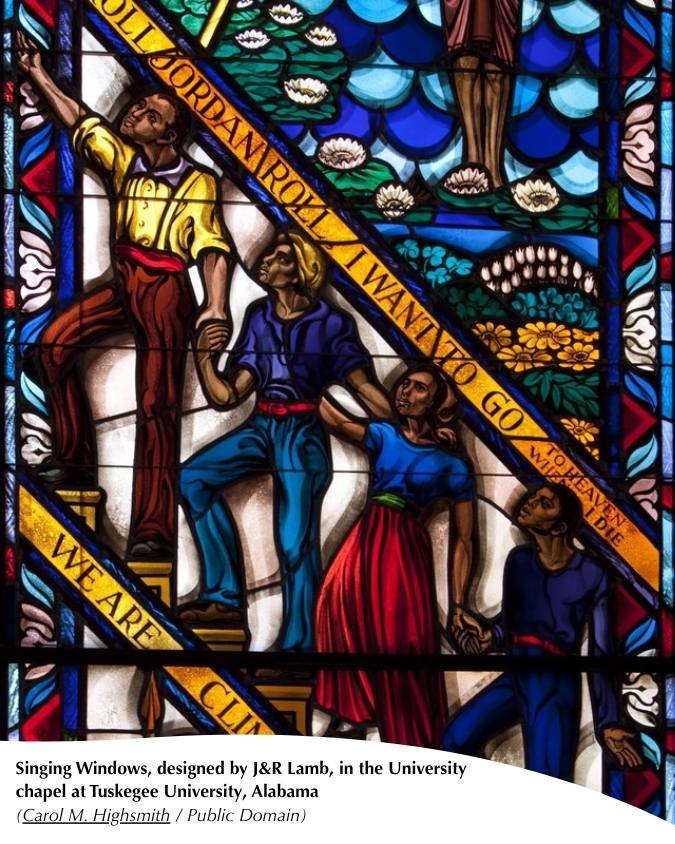 Born in the crucible of slavery — part African musical inheritance, part Christian hymn, wholly something new — the spiritual carried within it a melodic and emotional vocabulary that Western classical and choral music had not encountered before. Its influence on those traditions would prove to be both profound and enduring.
The spiritual's most immediate gift to choral music was its use of human voices as an instrument of communal testimony. While European choral writing had long prized precision, blend and formal text-setting, the spiritual introduced more raw and immediate ingredients: the call-and-response structure inherited from West African musical traditions, a fluid relationship between soloist and choir, and a tolerance — even a celebration — of vocal expressivity over technical conformity. When European composers and choral directors began absorbing these elements in the late nineteenth and early twentieth centuries, they found themselves with an entirely new expressive palette.
 One figure who did much to bridge these worlds was Harry T. Burleigh, a baritone and composer who studied at the National Conservatory of Music in New York and befriended the Czech composer Antonín Dvorák in the 1890s. Burleigh introduced Dvo?ák to the melodies and structures of African American folk and spiritual music, and the results were transformative. Dvo?ák's New World Symphony — one of the most celebrated works in the classical canon — bears clear spiritual inflections in its famous largo movement, with its modal harmonies, pentatonic contours, and aching sense of longing. Dvo?ák famously declared that African American music should form the foundation of a distinctly American classical tradition; a vision that proved prescient even if it took decades to materialise fully.
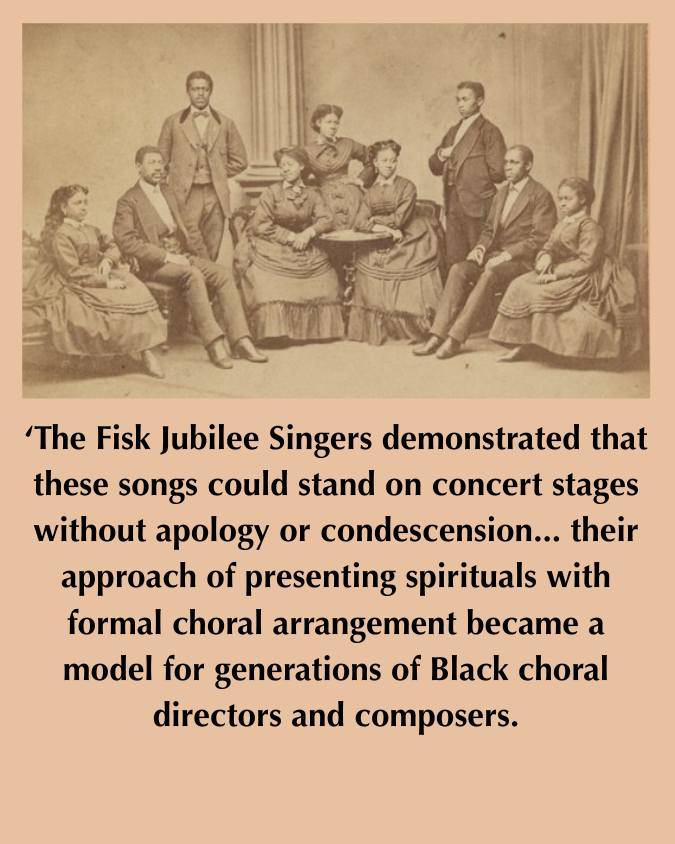 The Fisk Jubilee Singers, formed in 1871 by formerly enslaved people and their descendants at Fisk University in Nashville, were perhaps the single most important ambassadors of the spiritual to mainstream and international audiences. Their tours of the United States and Europe not only raised funds for the university but introduced European listeners — including royalty and leading musicians — to a repertoire of startling beauty and sophistication. They demonstrated that these songs could stand on concert stages without apology or condescension, and their approach of presenting spirituals with formal choral arrangement became a model for generations of Black choral directors and composers.
The Harlem Renaissance during the 1920s and 30s was an explosion of African American culture, art and music, which deepened this integration. Composers including Florence Price, William Grant Still, and later William Dawson absorbed the spiritual not as a curiosity or a folk artifact but as a living artistic resource. Price's symphonies and choral works weave spiritual melodic cells into large-scale classical forms with technical mastery and emotional directness.
The influence continues to reverberate. Contemporary choral composers, John Rutter among them, frequently draw on blue notes, rhythmic asymmetry, and the improvisatory freedom the spiritual modeled. Gospel-inflected choral writing has become a recognised genre in its own right. And in university music programs, the spiritual is no longer studied as an appendix to Western tradition but as one of its formative chapters — a corrective to any account of classical music that forgot to include the voices that changed it so significantly.
Join us for Songs of the Spirit
St Mary's Priory Church, 7:30pm 6 June 2026
Tickets: £15 (under 18s free) Book here>>
Join Monmouth Choral Society for a wonderful evening of Songs of the Spirit.
From the stirring sounds of composers such as Florence Price and Samuel Coleridge Taylor, to the lively arrangements of John Rutter's Feel the Spirit, our performance explores the poignant yet hopeful world of African American spirituals and their influence on choral music.
Alongside new arrangements of Welsh folk songs, and a second performance of Eloise Gynn's haunting choral soundscape Wye, our summer programme seeks to convey music's answer to the most fundamental human longings - freedom, hope, and justice.